
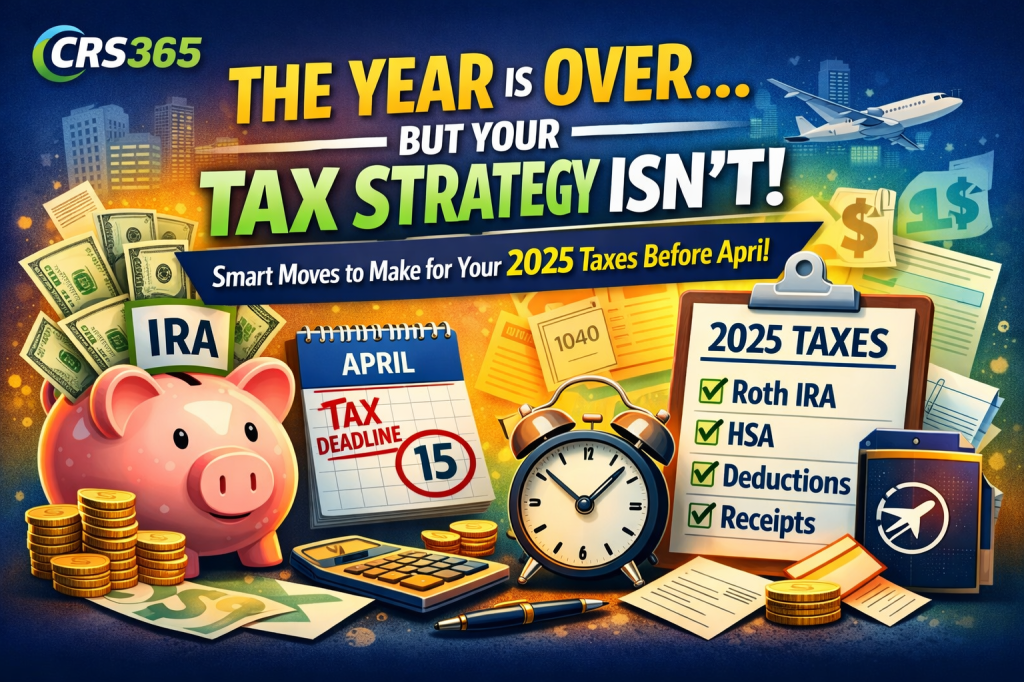
You made it.
2025 is officially in the rearview mirror.
The calendar flipped, the holidays passed, and everyone is already talking about new goals, new plans, and “fresh starts.” But if we’re talking taxes? You’re not done with 2025 yet—not even close.
In fact, this is the part most people miss.
Because the truth is: Your tax focus should still be on the prior year until your return is filed.
We have plenty of time to talk about 2026 tax strategy. For now, keep that mental focus on 2025.
That means from January through April, you still have real leverage. There are real adjustments you can make that can reduce your tax bill, boost retirement savings, and tighten up your records so you don’t miss deductions you earned.
And one more important point before we dive in:
The 2025 tax changes are not done yet.
There are still discussions, policy shifts, thresholds, and rule tweaks that could impact how things play out—especially for business owners, high earners, and anyone balancing multiple streams of income.
So no, we’re not done talking taxes. We’re just moving into Phase 2.
Let’s break down exactly what you can still do now that the year is over, but before your taxes are due in April.
1) The “Stuff Your IRA” Window is Still Open (Yes, Even in 2026)
This is one of the simplest and most overlooked tax plays available after the calendar year ends.
Even though 2025 is done, the IRS still allows you to contribute to an IRA for the prior tax year up until the tax filing deadline (generally mid-April). That means you can still make a contribution that counts for 2025 in early 2026.
Why this matters
Because an IRA contribution can do one of two powerful things:
- Reduce taxable income (Traditional IRA deduction)
- Build tax-free growth for the future (Roth IRA)
And depending on your income and situation, you might be able to use both options strategically.
Traditional IRA: possible deduction for 2025
Traditional IRA contributions may be tax-deductible, which can reduce your adjusted gross income (AGI). But there’s a catch: deductibility depends on your income and whether you (or your spouse) have access to a workplace retirement plan like a 401(k).
So while the move can still be valuable, it’s not a guaranteed deduction for everyone.
Roth IRA: the best deal in retirement… when allowed
A Roth IRA is incredible because the growth and withdrawals can be tax-free in retirement. The problem is Roth IRAs have income limits, and many high earners exceed them.
Which leads us directly to the next move.
2) High-Income Earners: How to Do a Roth IRA Anyway (Backdoor Roth Strategy)
If you’re a higher-income earner, there’s a good chance you’re in this category:
- You maxed out your 401(k) already
- Your income is too high to contribute directly to a Roth IRA
- You either can’t deduct a Traditional IRA, or you don’t want to
So what now?
This is where the Backdoor Roth IRA comes in.
And yes—despite the name, it’s completely legal and widely used. It’s essentially a tax strategy built into the rules.
What a Backdoor Roth IRA actually is
A Backdoor Roth IRA is a two-step process:
- Contribute to a Traditional IRA (non-deductible)
- Convert that contribution to a Roth IRA
Because there are no income limits on conversions, high-income earners can get money into a Roth IRA even if they can’t contribute directly.
Why it works
You contribute money to a Traditional IRA, but you don’t take a deduction (meaning you already paid taxes on it). Then you convert it to Roth. Since the original contribution was after-tax, the conversion should be mostly tax-neutral.
That’s the ideal scenario.
The one thing you MUST understand: the Pro-Rata Rule
Here’s the part that trips people up.
If you already have money sitting in Traditional IRAs (including SEP IRAs or SIMPLE IRAs), the IRS does not allow you to convert “just the after-tax portion.”
Instead, they view all your IRA money as a blended mix of taxable and non-taxable dollars.
That means if you have existing pre-tax IRA balances, your Backdoor Roth conversion may trigger a tax bill.
This is called the pro-rata rule, and it’s the #1 reason people mess up Backdoor Roth planning.
How to make the Backdoor Roth cleaner
If you have a large pre-tax IRA balance, you may want to explore:
- Rolling your pre-tax IRA into your 401(k) (if your plan allows it)
- Consolidating older retirement accounts strategically
- Planning conversion timing with a tax professional
The point isn’t to scare you off—the point is to do it correctly.
Because for high-income earners, this is one of the best long-term tax plays available.
3) You Can Still Reduce Your 2025 Tax Bill with an HSA (If Eligible)
If you’re enrolled in a high-deductible health plan, you may qualify for an HSA (Health Savings Account).
This is one of the most tax-advantaged accounts in existence, because it offers the “triple benefit”:
- Contributions are tax-deductible
- Growth is tax-free
- Qualified medical withdrawals are tax-free
Even better: like IRAs, you can typically contribute for 2025 up until the tax filing deadline.
Why business owners love HSAs
Because an HSA can reduce taxable income while also acting as a stealth retirement account. Many high earners pay medical expenses out-of-pocket and let the HSA grow untouched for decades.
If you’re eligible and not using this account, you’re leaving money on the table.
4) Self-Employed? You Still Have Retirement Options After Year-End
If you’re self-employed (or own a business), your post-year-end planning options are often even stronger—especially depending on entity type and filing strategy.
SEP IRA contributions can be massive
A SEP IRA allows large contributions relative to income. And in many cases, SEP IRA contributions can be made later than April if you file an extension.
Solo 401(k) options
Solo 401(k)s can be extremely powerful, but the setup timing rules matter. Employer contributions may be possible later, but not everything can be done after the year closes if the plan wasn’t established in time.
This is why post-year-end tax planning matters so much: it’s not just “what did I do last year?” It’s “what can I still do to optimize last year?”
5) The April Deadline Is Your Real Finish Line (Not December 31st)
A lot of people view tax planning like it ends on New Year’s Eve.
In reality, for most taxpayers, the finish line is when you file.
January through April is when you:
- gather documents
- reconcile reality
- correct mistakes
- capture deductions you forgot
- make final contributions that reduce taxable income
- prepare your return strategically instead of rushing it
And if you’re a business owner or high-income earner, this is the time to ensure the story your tax return tells is accurate and optimized.
Because once you file, the window closes.
6) Why You Need to Stay Locked In: 2025 Tax Changes Aren’t Final Yet
This is a big one.
The tax landscape continues to shift. There are still proposals, discussions, and possible adjustments being made that may impact:
- thresholds
- deductions
- phaseouts
- credit eligibility
- business tax treatment
- retirement account rules
- and planning assumptions people make too early
So if you’re tempted to make confident assumptions about “how it’ll work this year” — don’t.
Your best strategy is to:
- keep your 2025 records clean
- take advantage of the actions you can control now
- and stay aware that the rules may still evolve as we move through the filing season
Tax planning isn’t static. It’s responsive.
7) Final Reminder: Don’t Forget What You Already Did in 2025
This is the “silent leak” that costs people money every single year.
Even if you didn’t do every strategy perfectly, you may have already created valuable deductions and write-offs during 2025… and the only thing that can ruin it now is not capturing it properly.
So before you hand everything off to your accountant—or before you upload documents into TurboTax—make sure you have notes on what actually happened.
Here are a few common categories that get missed:
Home office expenses (business owners)
If you used part of your home regularly and exclusively for business, you may have:
- internet expenses
- a portion of rent or mortgage
- utilities
- home repairs related to the office space
- office furniture and equipment
Even if you’re not doing a formal “home office deduction,” many related expenses still matter.
Business travel in 2025
You’d be shocked how many people forget legitimate business travel write-offs:
- flights
- hotels
- Uber/Lyft
- parking
- conference fees
- meals (when properly documented)
If you traveled for business, write down what it was for and when it happened—your memory will not be as sharp in March as it is now.
Equipment, software, and subscriptions
Did you purchase:
- a laptop
- a new phone for work
- monitors
- a printer
- business software
- subscriptions like Google Workspace, QuickBooks, Canva, Adobe, CRMs, email tools, etc.
These often slip through the cracks if you don’t summarize them now.
Contractor payments and outsourced services
If you hired help—designers, VAs, freelancers, consultants—make sure you have a list of:
- who you paid
- how much
- how they were paid (PayPal, Stripe, Venmo, ACH)
- what the work was for
It’s not just for deductions—it also impacts whether you need to send 1099 forms.
Mileage and vehicle use
If you used your vehicle for business purposes, even part time, the mileage adds up fast. If you didn’t track it throughout the year, reconstructing it now is far easier than trying to “guess” later.
The Bottom Line: You Still Control the Outcome
Yes, 2025 is technically over.
But your tax strategy for 2025 is still alive.
You still have time to make smart moves—like funding retirement accounts, using a Roth conversion strategy (even as a high-income earner), maximizing an HSA, and tightening up your records so you don’t miss deductions you already earned.
The worst thing you can do right now is assume it’s “too late” and file the return as-is.
The best thing you can do is treat January through April like the final stretch of the race—because that’s exactly what it is.
And if you want the simplest action step to take today?
Open a note on your phone titled:
“2025 Tax Notes”
Then list:
- big purchases
- trips
- home office items
- subscriptions
- anything business-related you don’t want to forget
Your future self will thank you when filing time gets hectic.
CRS365 Team
 Consulting Research Services